L&T Archive 2003-2014
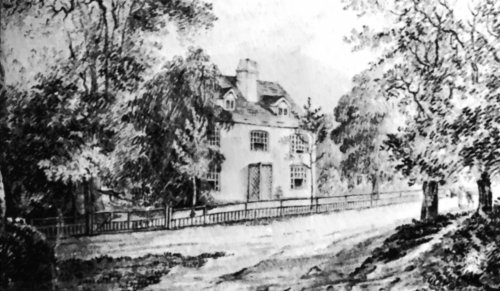
 Above is a sketch of Steventon Rectory, 1814
] Well, the early 19th century is our era. To be sure, the parson had to maintain the parsonage out of his income, plus whatever the generosity of the patron, or his own family's wealth, might contribute. It would follow that the richer the living, the better the standard of accomodation.
Correct, except for the fact that the patron didn't have anything to do with the upkeep of the parsonage- that was between the parson and his bishop. Irene Collins, in her book Jane Austen and the Clergy explains in quite a lot of detail that of the five thousand or so parishes, about two thirds didn't produce enough to live on, and in fact, many didn't even posess any kind of official building for the parson to live in. In many others, the parsonage was woefully inadequate. To give a few examples, Deane parsonage was so small and leaky that Mr Austen refused to live in it: instead he rented a cottage in the village. Steventon Parsonage may have had five bedrooms, but at least two of those were attic rooms, and in that situation, lived not only Mr Austen and his wife , but also his children, several schoolboys and a couple of servants. He did put some money into the place, but even then , it was hardly a luxurious home. Collins' book shows architects plans for rectories that were published in JA's lifetime; three bedroomed dwellings are pretty common in these.
Improvements made by one incumbent would benefit all of his successors.
Yes, if there was money to keep them improved. The fact that so many of them were completely rebuilt post Napoleonic wars, suggests to me that the church comissioners were right in that too many of them were not decent at all.
I suspect that as the social status of the Anglican clergy rose through the 18th and into the 19th century, their residences went through a process of steady cumulative improvement.
Yes, that's true. Of the parsonages JA knew, Mr Papillion's new one at Chawton, and the Lefroy one at Ashe, are strongly built, spacious, and very pretty. They are extremely desirable houses, even today- I believe the Ashe Rectory (plus acres and trout stream) was on the market last year for £2.5 million. There is no doubt that the general improvement in church housing that the ecclesiastical authorities were so approving of in the 1830's actually started during JA's lifetime. She would have known several comfortable parsonages as well as poor ones.
] As to those parishes which totally lacked accommodation, query how many of them were held in plurality.
Although there were parishes that lacked accomodation (there was no rule that said that the church had to provide it per se), I don't know that you can correlate them with pluralities. Pluralities was tied to income, not to ecclesiastical edict.
Query also how many were in the poorer and more sparsely populated areas of the North of England.
The "poorer and more sparsely populated areas" don't correlate particularly well with provision of parsonages, although they might well correlate with poorly maintained ones! First of all, the the North of England, parishes tended to be large in area. That was partly a result of initial low population densities, but also of historical accident. By JA 's time some of the North of England had the densest populations in England outside the Capital region ( a situation which exists to this day.) There may have been few parsons per hundred square miles, and hence few parsonages, but pluralities were no greater or lesser in the North than elsewhere.
Poverty did not coincide with low population density, any more than it did with the "North of England". There were plenty of smaller pockets where population density was quite high, and poverty was rampant. Sarah Trimmer and Hannah More found thirteen contiguous parishes in the Mendips with no resident parson at the end of the eighteenth century. That was assumed to be a result of poverty (mainly the collapse of the local wool industry) and I think that one can assume that such parsonages that existed in these parishes were pretty poor affairs. What cannot be assumed, however, is that the population density was low- it can be proved otherwise by census data and parish registers. (And yes, the registers did exist, even if the parson was itinerant and/or absent most of the time.)
As an addition, those Pemberleans who are acquainted with that extremely comfortable seventeenth century rectory known as Old Alresford Place, may wish to know that this particular building was considered to be way over the top of what was suitable by the church authorities at the time, and they very nearly refused permission for its building. The fact that most of the funds came fom the income of the incumbent doesn't seem to have tempered their comments on the subject. Howevr, in the end, they did not refuse permission, and the house was built. It was far and away the grandest rectory in the diocese in JA's time, and I believe that even in the Victorian building boom , no other grander residence was built. OAP was a "five thousand a year" house, for sure.